Bridging the Gap: Aligning IT Strategies with Corporate Goals for Success In today’s digital landscape, the role of a Remote IT Director is more critical than ever. As organizations increasingly rely on technology to drive growth and innovation, aligning IT strategies with corporate goals has become essential. This article explores the key steps Remote IT Directors can take to ensure their IT initiatives are closely aligned with business objectives, ultimately driving success and maximizing ROI. 1. Understand the Business Goals The first step in aligning IT strategies with corporate goals is gaining a deep understanding of the organization’s mission, vision, and long-term objectives. A Remote IT Director must be familiar with the company’s industry, market challenges, and competitive landscape. This knowledge allows for the development of IT strategies that support business growth, enhance operational efficiency, and deliver tangible value to the organization. 2. Collaborate with Key S...
Posts
Showing posts with the label pa
Best Practices for Effective IT Service Management in Remote Work Environments
- Get link
- X
- Other Apps
The shift to remote work has redefined the landscape of IT service management (ITSM), presenting new challenges and opportunities for organizations. With employees dispersed across various locations, IT teams must adapt their practices to ensure seamless service delivery, maintain security, and support productivity. Effective ITSM in remote work environments requires a blend of strategic planning, the right tools, and a proactive approach to managing the unique needs of a remote workforce. 1. Establish Clear Communication Channels Effective communication is critical in remote work environments. IT teams must ensure that employees can easily reach out for support and that issues are resolved promptly. Establishing clear communication channels is the first step in achieving this: Utilize Multiple Communication Platforms : Offer various communication options such as email, chat, video calls, and phone support. Tools like Slack, Microsoft Teams, and Zoom can facilitate real-time interactio...
How IT Management Can Enhance Business Continuity Planning
- Get link
- X
- Other Apps
In today's interconnected business environment, ensuring uninterrupted operations is paramount. Business continuity planning (BCP) is a strategic approach that prepares organizations for potential disruptions, enabling them to maintain critical functions during emergencies. IT management plays a vital role in enhancing business continuity by ensuring that technology infrastructure, data, and processes are resilient, reliable, and recoverable. This article explores how IT management can enhance business continuity planning and ensure organizational resilience in the face of unforeseen challenges. 1. Integrating IT with Business Continuity Planning Effective business continuity planning requires a close integration between IT management and overall business strategies. IT managers must align IT processes, infrastructure, and resources with the broader business continuity objectives: Collaborate with Business Units : IT managers should work closely with business units to understand th...
Navigating Cybersecurity Challenges: A Guide for IT Managers
- Get link
- X
- Other Apps
In today’s digital age, cybersecurity is a critical concern for organizations of all sizes. As businesses become increasingly reliant on technology, the threats they face have grown in sophistication and frequency. For IT managers, navigating these cybersecurity challenges is a top priority, as even a single breach can have devastating consequences, including financial losses, reputational damage, and regulatory penalties. This guide explores the key cybersecurity challenges facing IT managers today and provides strategies for effectively addressing them. 1. Understanding the Evolving Threat Landscape The cybersecurity threat landscape is constantly changing, with new threats emerging regularly. IT managers must stay informed about the latest trends and tactics used by cybercriminals to effectively protect their organizations: Sophisticated Cyber Attacks : Cybercriminals are using increasingly sophisticated methods, such as advanced persistent threats (APTs), ransomware, and zero-day e...
Building a Resilient IT Infrastructure: Key Considerations for IT Managers
- Get link
- X
- Other Apps
In today’s rapidly evolving digital landscape, building a resilient IT infrastructure is not just a priority it’s a necessity. As businesses increasingly rely on technology to drive operations, any disruption can have significant consequences, from financial losses to reputational damage. For IT managers, the challenge lies in designing and maintaining an infrastructure that can withstand various disruptions, adapt to changing needs, and ensure continuous service delivery. This article explores the key considerations for IT managers in building a resilient IT infrastructure that supports business continuity and growth. 1. Understand and Assess Risks The foundation of a resilient IT infrastructure begins with a thorough understanding of the risks that could impact your organization. Identifying and assessing these risks is crucial for developing strategies to mitigate them: Conduct a Risk Assessment : Start by identifying potential threats, such as natural disasters, cyberattacks, hardw...
The principles of project management
- Get link
- X
- Other Apps
The principles of project management serve as the guiding foundation for effective project execution. One fundamental principle is clarity in project objectives. Clearly defined and communicated objectives provide the project team with a shared understanding of what needs to be achieved. This principle emphasizes the importance of having SMART (Specific, Measurable, Achievable, Relevant, Time-bound) objectives that are aligned with the overall organizational strategy. With well-defined objectives, project managers and team members can focus their efforts on delivering tangible results, fostering a sense of purpose and direction. Another crucial principle is stakeholder engagement and communication. Successful project management recognizes the significance of actively involving and communicating with stakeholders throughout the project lifecycle. Engaging stakeholders from the beginning helps in gathering valuable input, managing expectations, and building a collaborative environment. E...
Project Management eight performance domains
- Get link
- X
- Other Apps
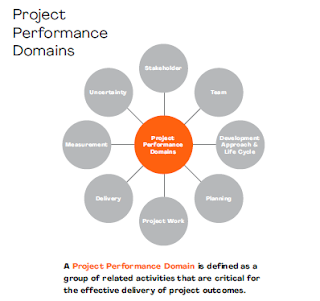
The Project Management Professional (PMP) certification, administered by the Project Management Institute (PMI), encompasses a comprehensive examination of project management competencies across eight performance domains. These domains serve as the foundation for evaluating a project manager's skills and knowledge. Initiating, the first domain, involves defining the project at a broad level and obtaining approval to move forward. This includes developing a project charter, identifying stakeholders, and conducting a high-level risk assessment. In the Planning domain, project managers delve into detailed project planning, covering aspects like scope definition, scheduling, cost estimation, risk management, and resource planning. This phase is crucial for establishing a roadmap that guides the project throughout its lifecycle. Executing, the third domain, focuses on turning the project plan into action. Project managers must coordinate people and resources, manage stakeholder expectat...
A measurable outcome in project management
- Get link
- X
- Other Apps
A measurable outcome in project management refers to a specific, quantifiable result or achievement that can be objectively assessed to determine the success or progress of a project. Measurable outcomes are often expressed as key performance indicators (KPIs) or key results within a goal-setting framework, such as Objectives and Key Results (OKRs). These outcomes provide a concrete and numeric way to gauge whether a project is meeting its objectives and staying on track. For example, if a project objective is to "improve customer satisfaction," a measurable outcome could be stated as a key result: "Increase customer satisfaction survey scores by 15% within the next quarter." In this case, the measurable outcome is the percentage increase in customer satisfaction scores, providing a clear benchmark for success. Measurable outcomes serve several purposes in project management: Clarity: They provide clear and specific criteria for success, leaving little room for ambi...
Project Management Objectives and Key Results
- Get link
- X
- Other Apps
OKRs, or Objectives and Key Results, are a goal-setting framework that originated in the business world and is widely used in project management to align teams and individuals with overarching organizational goals. The OKR framework typically consists of two main components: Objectives: These are clear and ambitious goals that articulate what an organization or team wants to achieve. Objectives are qualitative and provide direction, helping to set a clear vision for what success looks like. Key Results: Key Results are specific, measurable outcomes that indicate whether the objective has been achieved. They serve as quantifiable milestones or performance indicators that provide a tangible way to assess progress toward the objectives. OKRs are designed to be transparent and collaborative, encouraging regular check-ins and updates to track progress. They promote a results-oriented approach by focusing on outcomes rather than just outputs. OKRs are typically set at multiple levels within ...
Project Management Keeping teams active
- Get link
- X
- Other Apps
Keeping teams active and engaged in project management is crucial for achieving project success. Firstly, fostering a collaborative and inclusive team culture is essential. Encouraging open communication, valuing diverse perspectives, and creating an environment where team members feel heard and appreciated can significantly boost motivation. Regular team meetings, both in-person and virtual, provide opportunities for collaboration, brainstorming, and sharing progress. Effective team leaders recognize the strengths of individual team members and leverage them to enhance overall team performance. By cultivating a positive and supportive team culture, project managers can maintain team enthusiasm and commitment to project goals. Secondly, establishing clear roles and responsibilities is vital for keeping teams active and accountable. When team members understand their specific contributions and how they fit into the larger project framework, they are more likely to stay engaged and take ...
Project management fundamentals
- Get link
- X
- Other Apps
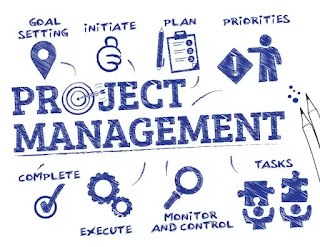
Project management fundamentals are the essential principles and practices that form the backbone of successful project execution. At its core, project management involves initiating, planning, executing, monitoring, and closing a project to achieve specific goals within defined constraints. One of the key fundamentals is the establishment of clear project objectives and scope, outlining the desired outcomes and boundaries to guide the entire project team. This foundational step helps prevent scope creep and ensures that the project stays on track. Effective communication is another critical aspect of project management fundamentals. Clear and consistent communication among team members, stakeholders, and other relevant parties is essential for understanding expectations, addressing issues, and fostering collaboration. Establishing a communication plan that outlines the channels, frequency, and methods of communication helps mitigate misunderstandings and keeps everyone informed and al...
SMART goals in project management
- Get link
- X
- Other Apps
SMART goals in project management are specific, measurable, achievable, relevant, and timely. SMART goals can help ensure that objectives are attainable within a certain time frame. Here are some tips for setting SMART goals: Measurable: The goal should be quantifiable, or at least allow for measurable progress. Attainable: The goal should be realistic, based on available resources and existing constraints. Relevant: The goal should align with other business objectives. Time-bound: The goal must have a deadline. Some other project management goals include: Improving communication and collaboration Increasing productivity Morgan Todd Lewistown, PA 17044 https://www.linkedin.com/in/wiredwizard/
Morgan Todd Lewistown PA Flash Back Pictures 042420542
- Get link
- X
- Other Apps
Morgan Todd Lewistown, PA Covering the basics of the forex market
- Get link
- X
- Other Apps
The foreign exchange, or forex, market is relatively young, having begun in the early 1970s after the United States dropped the gold standard and national currencies started to fluctuate widely. For about 30 years prior to that, most nations had agreed to keep their currency values stable in relation to the U.S. dollar, making a forex market unnecessary. With that no longer the case, banks quickly realized that a profit could be made in “buying” currency when it was devalued and “selling” it after it strengthened, just like any other commodity. Today, the forex market handles about $1.9 trillion in transactions every day, and it runs 24 hours a day, five days a week. (With nations around the world involved, it’s always daytime somewhere.) The most traded currencies are the U.S. dollar, the euro, Japanese yen, British pound, Swiss franc and Australian dollar. The forex market is overwhelmingly dominated by international banks, government banks, investment banks, corporation...
Secretary of State: Election Returns Website Offers First Look at Pennsylvania’s Vote Count
- Get link
- X
- Other Apps
Harrisburg, PA – With Tuesday’s primary election just ahead, Acting Secretary of State Robert Torres today reminded Pennsylvanians that the Department of State’s election night returns website offers up-to-the-minute statewide results. "Our election returns site gives the public, candidates, and the press the earliest and most complete picture of how the electorate voted," Torres said. "Our collaboration with the 67 county election offices allows us to consolidate their results as soon as they are available." The portal allows users to customize searches, receive timely updates and view results on mobile devices. The site also provides direct links to each county’s election results website. Visitors to the site can take advantage of a location-based service through the "My County" link which instantly brings up results for the county in which the user is located. The election returns website can be accessed at electionreturns.pa.gov . The de...